Having spent more than 15 years of my life developing innovative, tech-driven solutions to help nonprofits fundraise more effectively, I’ve had a front-row seat to the unpredictable roller coaster of our economic environment. I’ve seen the highs and lows—the accelerations and stalls—alongside trends, recessions, recoveries, policy shifts, tax deduction changes, and everything in between.
If you’re reading this, chances are your organization is feeling the pressure too—whether due to shrinking donor pools, rising costs, or shifting public policy. You’re not alone.
That’s why I thought now would be a good time to take a closer look at what’s really happening in the fundraising landscape. And by "now," I mean the past six months of 2025. My goal is to make sense of the macro-trends at play and how the market is actively evolving. I also want to outline how Charitybuzz can be part of the solution—but I’ll save that for next month’s post (so this one doesn’t become the digital equivalent of a sleep aid).
Let’s begin with what we know: Recent research from the last half-year makes it clear that nonprofits are under immense fundraising pressure, driven by a convergence of significant, rapidly shifting factors.
While there are easily a dozen or more trends worth exploring, I want to highlight five of the most prominent—and likely most relevant—to your work today:
1. Decline in Donor Numbers, Especially Small Donors
2. Increased Reliance on Large Donors (Donor Consolidation)
3. Worsening Donor Retention Crisis
4. Rising Costs and Static Budgets
5. Cuts in Federal Funding and Policy Shifts
In today’s age of AI and with access to some of the most powerful tools I’ve ever encountered (yes, I’m a 49-year-old who remembers when Excite, Lycos, Napster, and Google first hit the scene), I’ve been using these tools to help streamline the process of gathering, analyzing, and synthesizing data across these areas.
What follows below is my best attempt to distill that research into something digestible, insightful, and—hopefully—in part two—actionable.
1. Decline in Donor Numbers, Especially Small Donors:
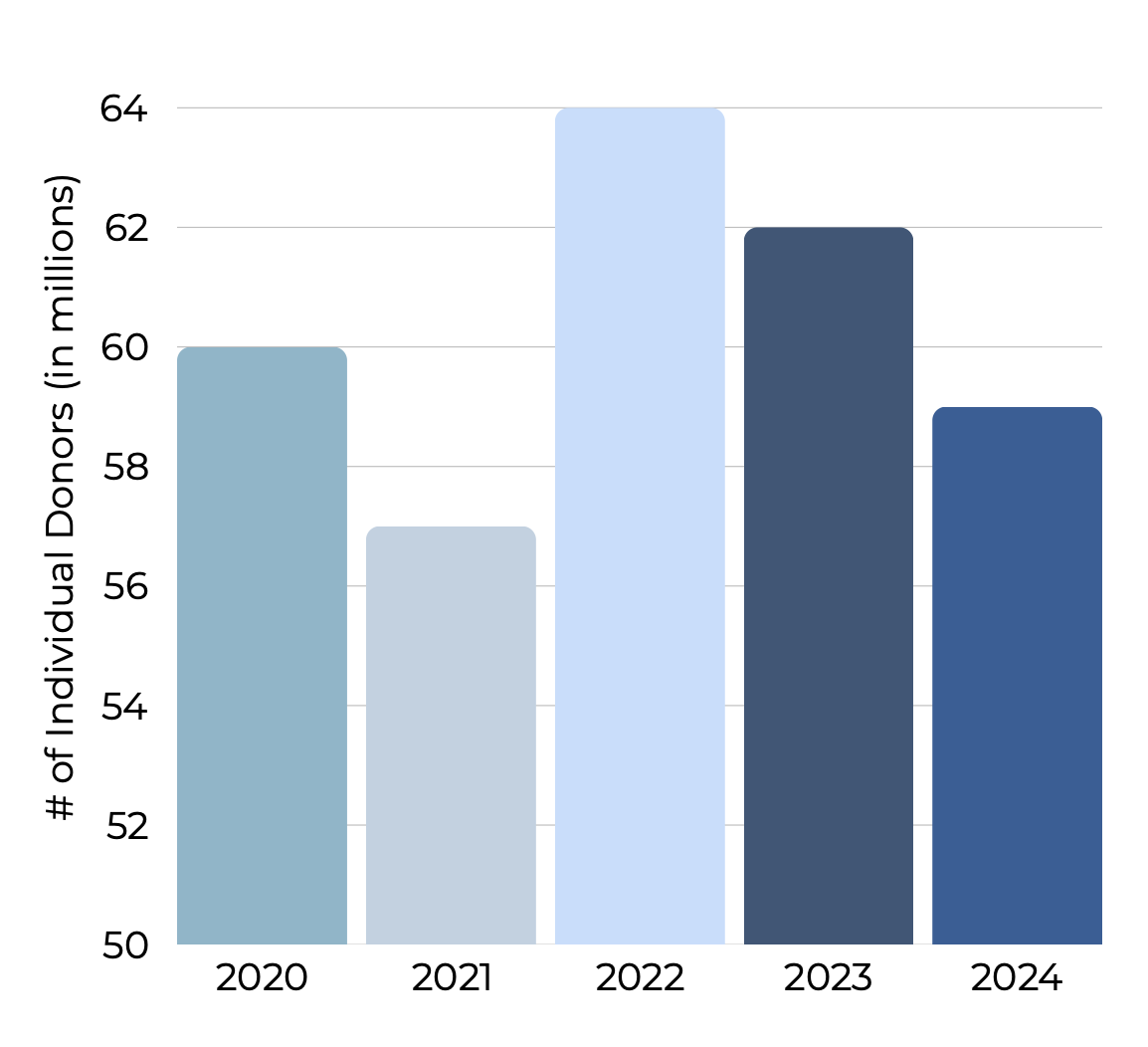
The nonprofit sector is facing significant challenges due to a steady and troubling decline in donor participation—particularly among small-dollar donors who have historically formed the backbone of charitable giving. According to data from the Fundraising Effectiveness Project (FEP), updated through Q4 2024 and Q1 2025, the total number of donors has dropped by 4.5% year-to-date through the end of 2024. This marks the fourth consecutive year of decline in overall donor count.
The most notable pressure point is the sharp drop in micro donors—those contributing between $1 and $100. This group experienced an 8.8% year-over-year decrease and now accounts for approximately 75% of the total donor attrition. This trend is especially concerning because these small-dollar donors traditionally serve as a pipeline for long-term engagement and larger future contributions.
Adding to the challenge, the broader landscape of charitable giving has also shifted: the percentage of American households that donate to charity has fallen from 66% two decades ago to just 50% today. Together, these trends underscore a systemic contraction in donor engagement and signal the urgent need for nonprofits to rethink how they attract, retain, and cultivate donor relationships—especially at the grassroots level.
2. Increased Reliance on Large Donors (Donor Consolidation):
Although overall charitable giving appears to be growing modestly—with a 3.5% increase in total dollars raised in 2024 compared to 2023, according to the Fundraising Effectiveness Project (FEP)—this headline masks deeper challenges. When adjusted for inflation, giving is actually slightly down, raising concerns about the real health of the philanthropic landscape.
Much of the reported growth is being driven by a smaller group of high-dollar donors, signaling a consolidation of giving into fewer, but significantly larger, gifts. Specifically, the number of Major Donors (those giving between $5,000 and $50,000) and Supersize Donors (gifts exceeding $50,000) has increased, while the number of donors in smaller giving categories continues to decline. This imbalance introduces new vulnerabilities for nonprofits: the loss of even a single major donor could cause serious disruption to operating budgets and program continuity.
Further compounding the challenge is that large gifts often come with restrictions—designated for specific programs or purposes—which can limit a nonprofit’s flexibility and make it harder to address emerging needs or invest in core infrastructure.
As a result, nonprofits are increasingly compelled to invest more time, energy, and resources into cultivating relationships with high-net-worth individuals. While necessary, this approach is resource-intensive and risks deprioritizing the broader base of small and mid-level donors that has traditionally provided long-term sustainability, community engagement, and financial resilience.
3. Worsening Donor Retention Crisis:
Donor retention is emerging as one of the most urgent challenges facing nonprofits in 2025. According to the Fundraising Effectiveness Project (FEP), the overall donor retention rate fell to 42.9% in 2024—a 2.6% drop from the previous year and the fifth consecutive year of decline. This downward trend signals increasing difficulty in keeping supporters engaged year over year.
The problem is particularly acute among first-time donors, only 18.5% of whom return to give again. This low rate of repeat giving makes donor acquisition an increasingly costly and inefficient strategy compared to retention. With the national donor churn rate now estimated at 55–60% annually, the sector is facing what many are calling a “retention catastrophe.”
This high attrition rate is putting intense pressure on nonprofits’ fundraising operations. Organizations must now spend more to replace lost donors—especially as acquisition costs rise—while simultaneously grappling with the loss of potential long-term value that loyal donors typically bring over time. Without significant improvements in engagement and stewardship, donor retention will remain a critical and unsustainable weak point in nonprofit fundraising.
4. Rising Costs and Static Budgets:
Nonprofits in 2025 are navigating a growing imbalance between rising operational costs and escalating demand for services—all while contending with stagnant or shrinking budgets. The sector is being forced to “do more with less,” as the costs associated with paper, postage, and digital advertising continue to climb. These increases are eroding the impact of every fundraising dollar and squeezing already limited administrative budgets.
At the same time, nonprofits are facing heightened demand for essential services such as food security, housing, and healthcare—needs that have intensified due to ongoing economic shifts and reductions in federal funding. This dual pressure of rising costs and expanding service demand is pushing many organizations to their operational limits, making efficiency, innovation, and donor engagement more critical than ever.
5. Cuts in Federal Funding and Policy Shifts:
Nonprofits are facing a precarious financial environment as federal funding reaches a critical tipping point. Forecasts indicate that discretionary domestic spending is set to decline significantly, with major cuts expected in essential areas such as housing, labor, and education. These reductions threaten the stability of many nonprofit programs that rely heavily on government support.
Compounding the financial strain is a volatile policy landscape. Sudden policy shifts can eliminate funding streams overnight, forcing nonprofits to scale back programming or lay off staff with little warning. This level of unpredictability makes long-term planning and sustained service delivery increasingly difficult.
Adding to the uncertainty is the pending expiration of the Tax Cuts and Jobs Act of 2017 (TCJA) in 2025, alongside active debates about tax policy changes—including the potential reinstatement of a non-itemizer charitable deduction. These legislative unknowns cast doubt over the future of charitable giving incentives, making it harder for nonprofits to forecast donor behavior and plan fundraising strategies with confidence.
So, what now? That’s really the bigger question, isn’t it? While the five points outlined above may have helped put some data behind the pressures you’re already feeling, chances are you’ve been experiencing many of these challenges firsthand in your day-to-day work.
As I mentioned earlier, the team at Charitybuzz is committed to being part of the solution. In next month’s blog post, we’ll share actionable ideas and potential strategies for addressing each of these five fundraising challenges. More importantly, we’ll show how our platform can play a meaningful role in helping you navigate this evolving landscape—and hopefully, bring down the pressure valve just a bit.
Stay tuned for the August edition. We’re excited to dig into the solutions with you.
To be continued!
- Matt Combs